
By Yogi Bhajan
"What is a spiritual name? Spiritual name is the designated destiny. That becomes your identity, rather your identity on the earth. Spiritual name is a heavenly identity, that's all it is. You may not live to it, you may live to it. But it's the guiding force.
And it's a prayer. When somebody called me Yogi Ji, it means one who is united with the greater soul. Or somebody called me Bhajan, it means a divine song. And somebody called me Har Bhajan Singh, it means the lion who sings the divine songs. It's a prayer. It's a prayer in another man's word. It's calling. What is a prayer? It's a calling. That's it. And you answer the call and you get uplifted.
It's a plus. It's a way to get other people blessings."
- Yogi Bhajan, April 22, 1990.
A spiritual name is more than just a word. It’s a powerful technology. Using Yogi Bhajan’s system of numerology and tuning in to the naad (inner sound) of your name, it can help you:
Enhance your personal and spiritual growth
Strengthen your soul’s identity and connection to the universe
Align with your highest destiny
Spiritual names given worldwide, guiding individuals on their unique spiritual journeys.
Over 50 years of tradition, rooted in the teachings of Yogi Bhajan.
Helping people in over 60+ countries to connect with their soul's identity.

"I am so thrilled and thankful for receiving my spiritual name!
Big honor for me to receive it from you! I will use it as a personal mantra for 40 days to integrate it!"
Liv Kamal Kaur
Artist, sound healing practitioner and Kundalini Teacher
Austria

Thank you for the blessing of this beautiful name. As I read your email, my eyes watered as the experience of meditation has changed my life, and I feel that my purpose is to share this with others via experience, so that they may have the path of enLightenment through the pure and powerful lineage that Yogi Bhajan has graced us with."
Jot Simrit Singh
Relationship Manager
United States

"I have received the paper with my new name, with Yogi Bhajan's photo. I have framed it and placed on my altar, and it brings inspiration, peace, and strength to reflect on it and to imbibe it."
Jeet Raj Singh
Foreign Service Officer
United States
Fill out the form with your birthdate and other personal details.
Using Yogi Bhajan’s system of numerology, Nirinjan Kaur will determine it and send it to you via email.
Listen to your name’s sound bite and delve into its meaning. Make it your personal mantra.




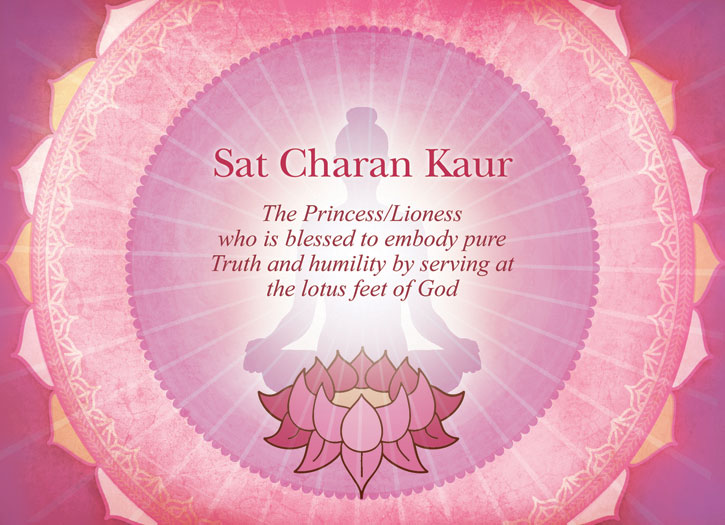



Within many traditions, a spiritual name is one given to a student by their teacher to enrich their sense of self. It serves as a marker towards one’s true identity, and an invitation to live consciously and lean into the unique embodiment of the soul.
Spiritual naming traditions exist in indigenous cultures worldwide and intend to encourage personal growth and conscious evolution.
This tradition of spiritual names is governed by the power of the naad, or sound current, and therefore the names function as vibrational tools for personal and spiritual growth. The names are based on numerology and your birth date. The naad (sound current) and meaning, unique to each name, helps you embody and project your soul identity.
Historically spiritual names were given by Yogi Bhajan. He trained Nirinjan Kaur to take over this role after his passing in 2004. Today, spiritual names are assigned by the Spiritual Names division of 3HO, headed by Nirinjan Kaur, who studied this methodology personally under Yogi Bhajan for over 30 years.
Spiritual names are assigned according to one’s birth date and numerology.
Spiritual names are derived from many traditions and languages, including Gurbani (which is contained in the Siri Guru Granth Sahib, the sacred Sikh scripture), Sanskrit, Hindi, and even English. Most are not traditional Sikh names, however they do share a connection through this scripture, as well as the use of the second names “Singh” and “Kaur.” This is a tradition carried over from Guru Gobind Singh, the 10th Sikh Guru. He gave the name “Singh” to every Sikh man and “Kaur” to every Sikh woman, as indicators of royalty in spirit. This legacy continues today through the use of these symbolic second names.
Historically, Singh was given as the second part of each spiritual name for men, and Kaur was given to women, a tradition that predates our modern awareness of the gender spectrum and gender fluidity. Kaur translates to “Princess” or “Lioness of God,” and Singh translates to “the Lion of God.” While these names are historically gendered, each individual that applies for a name is free to identify their own gender or choose not to be gender-specific.
When you feel inspired in your own consciousness and heart to ask for one, then you are ready to receive it. It is not, however, to be taken lightly or to be sought after simply because it is hip, trendy, or cool. Check in with your own soul and ask: Is this something I feel called to do? If the answer is yes, and you are prepared to approach the process with respect and commitment, you are encouraged to request a spiritual name.
Just as in English and many other languages, there may be more than one way to spell a name. Most of these names are derived from traditional Indian languages that have no direct correlation to the Latin alphabet. What matters is the sound current and the experience it evokes in consciousness.
Therefore, the pronunciation of your name is more important than the spelling. Please feel free to spell your name in a way that makes it easy for you and others to pronounce it correctly, or for suggested spelling, see the Pronunciation and Spelling page. If you do not find your name on the list, please email us.
Once you request a spiritual name, you will receive a sound bite to help you pronounce it correctly. Listen carefully to the sound bite and its pronunciation. You can also find most spiritual names and their pronunciations on the Pronunciations and Spellings page.
Listen to your name carefully and do the best you can to pronounce it accurately. If you cannot find your name on our list, or if you need more help learning how to pronounce it, please email us.
Taking on a new name is a major life change. Begin by getting acquainted with your new spiritual name. Meditate on its meaning. Tune in to how its naad (inner sound current) has the power to impact you. Write, chant, or recite it, silently and out loud. The name is your personal mantra. Allow it to reflect your inner depth, and remind you of your soul’s highest destiny. Once you become comfortable with it, you can begin integrating it in your daily life and ask others to start using your name.
As you make the transition, it may be helpful to use the 40 day rule. Kundalini Yoga says it takes 40 days to change a habit by retraining the mental process and nervous system. What if you tried using your name for 40 days? During this time observe how it affects you.
Change rarely comes easy. Just as it will take you time to accept and connect with your name, give your associates and family members space to embrace the change. Put yourself in their shoes, and have patience and compassion with them as you do yourself. Most of us prefer things to be easy and comfortable. Part of the decision to take on a spiritual name means taking a stand for your personal truth, and to hold to those values and commitments.
Make sure this feels true for you. If it does, they’ll adapt.
Any name that comes from the Siri Guru Granth Sahib carries the divine energy and power of Gurbani. If you meditate upon it, it can act as a guide in your life.
For some people, however, their given names—even if they come from the Siri Guru Granth Sahib—carry past associations, which may or may not have strong spiritual components. It is perfectly acceptable to ask for another name, knowing that this name is specifically for the purpose of building your spiritual identity and living your destiny. It is between you and your consciousness how you decide to approach it. In any case, it’s important to feel that your decision is right for you.
Some people receive more than one name. This could be due to duplicate request forms, computer errors, or a mistake on the part of the Spiritual Names Office. Whatever the reason, it is recommended that you use the first one received.
No, it is a personal choice whether or not to inherit a spiritual name. We highly suggest you take some time to learn the history, settle into your practice, and decide when or if it feels right for you.
To request a name, use the Spiritual Name Request Form.
In some cultures, a specific name may be used for one gender or the other. However, the spiritual naming system is not governed by traditional gender norms. This approach assigns names according to the person’s destiny, basing the names on their naad (inner sound current) and meaning.